
**Part 1: The Hidden Link Between Your Mind and Your Mess**
You know that feeling when you walk into a clean, organized space and instantly feel lighter.
It’s like a weight lifts off your shoulders, and suddenly, everything seems possible.
But here’s the twist: that sense of calm isn’t just about having a tidy room—it’s a reflection of your inner state.
However, what if I told you that decluttering isn’t really about cleaning at all?
I once tried self-hypnosis to tackle my own chaotic closet.
Hard to explain, but it felt like rewiring a stubborn part of my brain.
Instead of forcing myself to tidy up, I focused on how a clear space could mirror a clear mind.
And guess what? The motivation to organize suddenly felt effortless.
Think about your own home for a moment.
When surfaces are cluttered, does your thinking ever feel just as scattered?
It’s no coincidence.
Your environment acts like a mirror for your mental state—a messy room often echoes a chaotic mind.
But here’s the surprising part: you don’t need superhuman willpower to change it.
Let’s pause and consider this.
What if tidying up could become as natural as breathing?
In the age of endless digital distractions, our homes have become sanctuaries—or stress zones.
So why does organizing feel so daunting sometimes?
I’ll share a tiny story.
A client once described her cluttered desk as a “visual to-do list that never ended.”
She felt overwhelmed, almost paralyzed.
Then she tried a simple shift: she reframed cleaning as a gift to her future self.
And something clicked.
The act wasn’t a chore anymore—it was an act of self-care.
Your brain loves rewards, like dopamine—the brain’s “wanting” chemical.
Tidying can trigger it, but only if you connect it to positive feelings.
Ever notice how a freshly made bed gives you a small burst of pride?
That’s your mind celebrating order.
Here’s a gentle nudge: What’s one corner of your room that quietly stresses you out?
Imagine transforming it into a tiny oasis of calm.
You might find, as I did, that the outer order creates inner peace.
And who couldn’t use a little more of that?
Details
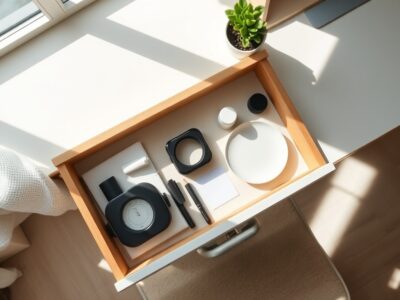
Now imagine applying that same gentle reframing to your own space, starting with just one drawer or shelf.
Begin by observing what you truly need versus what simply accumulates dust.
Each item you release creates physical and mental breathing room, like clearing fog from a window.
Notice how letting go of unused objects can subtly quiet the noise in your head.
Try spending five minutes each day in a single area, touching each belonging and asking, “Does this support the life I want?”
You might find that old receipts or duplicate kitchen tools carry hidden emotional weight.
Releasing them isn’t about loss—it’s about making space for what matters.
This practice builds momentum, turning resistance into gradual ease.
Pay attention to the calm that follows these small acts of curation.
Your mind begins to associate order with relief rather than chore.
Soon, you’ll naturally gravitate toward keeping surfaces clear because it feels soothing.
The cycle reinforces itself: a tidy space nurtures a focused mind, which in turn maintains the order.
Remember, this isn’t about perfection but progress.
Even a slightly organized corner can become an anchor of tranquility in a busy day.
Your environment and mindset will co-evolve, each small change supporting the other.
Let this be a quiet experiment in listening to what your space—and self—genuinely need.
Summary
Letting go of excess becomes a quiet ritual of self-care over time.
You may notice your thoughts flowing more freely in uncluttered spaces.
This mental clarity often sparks creativity or solutions to lingering problems.
Physical order seems to echo into your decision-making and relationships.
The process need not be rushed or perfected to yield benefits.
Even partially organized areas can serve as anchors of tranquility.
Your space gradually becomes a sanctuary that replenishes rather than depletes you.
Each choice to simplify builds a gentle resilience against life’s chaos.
Remember that maintenance feels lighter than initial clearing.
The peace you cultivate now will ripple through future days.
Your surroundings and mind can remain companions in calmness.
This harmony is where lasting contentment quietly grows.


Comments