
**Part 1: Why Your Brain Is Secretly Begging for a Hypnosis Class**
Ever wished you could rewire stubborn habits or quiet that mental chatter.
Imagine having a toolkit to gently guide your mind toward calm focus.
In the age of endless notifications, learning to direct your attention is almost a superpower.
But here’s the twist: most people picture hypnosis as a stage act with swinging pocket watches.
I once tried self-hypnosis after a stressful week, expecting little more than relaxation.
To my surprise, it felt like finding a dimmer switch for my anxiety—subtle but real.
However, the real magic isn’t about losing control.
It’s about gaining it.
Think of trance states not as “zombie mode” but as hitting your brain’s pause button—a chance to step back and choose your response.
Now, what if you could learn this skill hands-on in Tokyo.
Not through videos, but alongside others in a welcoming workshop.
Have you ever noticed how your shoulders tense when you’re rushed.
What if you could release that tension intentionally, like unclenching a fist.
Here’s a small story: A friend joined a beginner hypnotherapy session on a whim.
She described the hypnotic induction process as “daydreaming with purpose”—a lovely way to frame it.
We often forget that our brains love metaphors.
For example, suggestion works like planting seeds in fertile soil; you nurture them, and they grow.
By the way, the history of therapeutic hypnosis stretches back to ancient sleep temples.
It’s wild to think we’re rediscovering these techniques now.
So why does a Tokyo class matter.
It’s not just about techniques.
It’s about connection—learning to listen to your own mind, and maybe helping others do the same.
Hard to explain, but that shift from confusion to “aha” feels like coming home.
Curious how it works in practice.
Stay with me—we’re just getting started.
Details
Part 2: How to Start Your Hypnosis Journey in Tokyo.
Begin by finding a certified instructor who emphasizes safety and ethical practice.
Look for small group workshops that prioritize experiential learning over theory.
Many Tokyo studios offer introductory sessions in both English and Japanese.
These classes typically focus on practical skills like self-induction and stress management.
You don’t need special equipment—just comfortable clothing and an open mind.
The first session often starts with breathing exercises to establish relaxation.
Participants learn to recognize trance states through guided imagery exercises.
It feels similar to deep meditation but with more structured direction.
A common exercise involves imagining a “mental control room” where you adjust emotional dials.
This metaphor helps bypass conscious resistance to change.
Another technique uses progressive muscle relaxation to release physical tension.
Many students report immediate benefits like improved sleep and mental clarity.
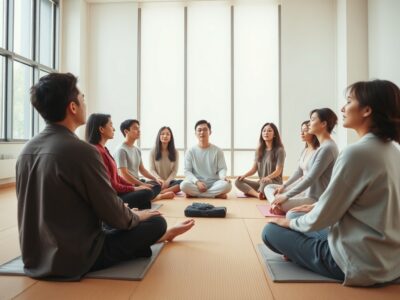
The social aspect of group practice creates a supportive learning environment.
Sharing experiences helps normalize the subtle sensations of trance.
You’ll discover that everyone’s experience with hypnosis is uniquely personal.
Some perceive it as heightened focus while others describe it as gentle detachment.
Remember that consistent short practice yields better results than occasional long sessions.
Even five minutes daily can strengthen your ability to enter focused states.
Many Tokyo instructors provide audio recordings for home practice between classes.
These help reinforce the skills learned during workshop sessions.
The ultimate goal is developing what psychologists call “response flexibility”.
This means creating space between stimulus and reaction in daily life.
You might notice yourself pausing before responding to stressful situations.
Or find it easier to shift out of negative thought patterns when they arise.
Consider trying a single introductory class before committing to longer courses.
Most studios welcome observers or offer trial sessions at minimal cost.
This lets you experience the group dynamic and teaching style firsthand.
Your journey into hypnosis should feel inviting rather than intimidating.
These skills become lifelong tools for navigating modern urban stress.
They help cultivate mental resilience amid Tokyo’s fast-paced environment.
The real value lies in discovering how to access your mind’s natural abilities.
You’re not learning something new but remembering what your brain already knows how to do.
Summary
Begin by integrating these techniques into your daily routine, perhaps during quiet moments in the morning or before sleep.
Consistency is more valuable than duration, so aim for brief, regular practice to build familiarity and trust in the process.
You might notice subtle shifts in how you respond to stress or approach challenges over time.
These small changes accumulate, fostering a sense of inner stability and clarity.
As you grow more comfortable, experiment with tailoring the exercises to suit your personal needs and goals.
For instance, use guided imagery to rehearse positive outcomes or muscle relaxation to unwind after a long day.
This adaptability makes hypnosis a versatile tool for enhancing well-being without drastic lifestyle changes.
Remember, the journey is deeply personal, and progress often unfolds at its own gentle pace.
Ultimately, this practice offers a quiet space to reconnect with yourself, away from the noise of everyday life.
It invites a mindful presence that can soften edges and open new perspectives.
Embrace it as a companion on your path, not a quick fix, and allow its effects to ripple through your days naturally.
May this exploration bring you peace and a renewed sense of possibility.


Comments