
**Part 1: The Unspoken Language of Modern Hypnosis**
You’ve probably seen stage hypnosis where volunteers cluck like chickens.
It’s entertaining, but it gives the wrong impression of what hypnosis truly offers.
Modern techniques are more like tuning a radio to a clearer frequency of your own mind.
I once tried self-hypnosis to curb my nail-biting habit, and the shift felt oddly natural.
But here’s the twist: the most powerful methods often use no words at all.
In Shinjuku’s buzzing heart, I met Kamisato Hiroshi after a Hypnosis Club event.
His approach felt like finding a quiet garden in the middle of a neon-lit city.
We discussed how nonverbal cues—a glance, a pause—can guide someone into deep focus.
For example, think of it as a dance where the hypnotist mirrors your rhythm until you sync up.
Why do we assume hypnosis needs complex scripts or mystical commands?
Tamura, a seasoned hypnotist, once described it as “listening with your eyes.”
Hard to explain, but it’s like sensing rain before the first drop falls.
In an age of endless notifications, these subtle techniques cut through the noise.
Did you know that 70% of communication is nonverbal?
That statistic isn’t just data—it’s a reminder of the quiet power we overlook.
Kamisato shared how spiritual discussions in Japan often blend ancient mindfulness with modern science.
It’s not about erasing your thoughts but rearranging them like furniture in a familiar room.
What if you could access that calm on a crowded train or before a stressful meeting?
By the way, the Hypnosis Club here hosts workshops that feel more like collaborative art than therapy.
Their events weave tradition with innovation, and honestly, it’s refreshing.
Details
In the heart of Tokyo, the Hypnosis Club continues to explore these silent methods, blending tradition with innovation.
Kamisato Hiroshi emphasizes that true hypnosis isn’t about control but about fostering a shared state of awareness.
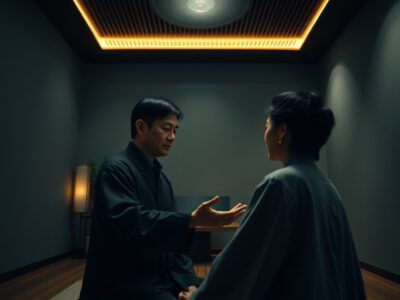
He demonstrated how a simple gesture, like a slow nod, can deepen relaxation without uttering a word.
This mirrors ancient practices where masters communicated through presence alone, much like a Zen garden’s tranquility.
Imagine applying this in daily life to pause the mental chatter and find clarity amidst chaos.
Tamura’s insights reveal that our brains are wired to respond to these subtle cues instinctively.
For instance, matching someone’s breathing pattern can create an unspoken bond, easing them into a receptive state.
It’s akin to how a skilled conductor guides an orchestra without disrupting the music’s flow.
Studies suggest that such nonverbal alignment boosts empathy and focus, making interactions more meaningful.
This approach demystifies hypnosis, showing it as a practical tool for personal growth.
In practice, these techniques help people reframe habits, like reducing anxiety or improving sleep, through gentle guidance.
Kamisato notes that many club members report feeling more in tune with their instincts after sessions.
They learn to notice the faint signals their minds send, turning inner noise into actionable insights.
It’s not about losing yourself but rediscovering the quiet wisdom that often gets drowned out.
By integrating these methods, one can cultivate resilience in a fast-paced world, step by step.
Summary
The subtle art of nonverbal hypnosis extends beyond formal sessions into everyday encounters, where a shared silence can foster profound understanding.
Imagine a conversation where a gentle tilt of the head or a synchronized breath bridges gaps words cannot fill, easing tensions and inviting introspection.
This approach draws from timeless wisdom, reminding us that the quietest gestures often hold the deepest resonance in human connection.
By embracing these unspoken rhythms, we learn to listen not just with our ears but with our entire being, cultivating moments of serene clarity.
In a world brimming with noise, such practices offer a gentle anchor, allowing us to navigate life with renewed presence and calm.


Comments